Share on Facebook
 Share on X
 Share by Email
 Share on Google Classroom
The Filles du Roi were a cohort of around 800 unmarried women sponsored by the King to immigrate to New France between 1663 and 1673. At the time, private interests instead gave priority to bringing over male workers. As a result, the French government and religious communities attempted to correct the gender imbalance in the colony. By facilitating the migration of the Filles du Roi, Minister Jean-Baptiste Colbert sought to incentivize male workers, who had finished their contract, and soldiers of the Carignan-Salières regiment (which had just been demobilized) to settle in the colony. Today, many people can trace their ancestry to the Filles du Roi.

Origin and Recruitment
The first female immigrants to Canada either came as nuns or with their families. Private recruiters, religious communities and landowners also sponsored small groups of unmarried women, hoping that they would start families. However, the number of women was still not nearly enough to fulfill the needs of the colony. In 1666, the colony had a population of 3,200, of which only a third were women. This imbalance hindered the colony’s demographic growth.
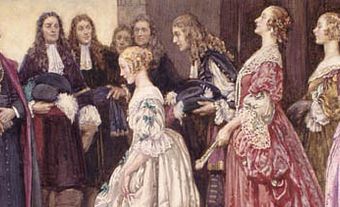
To help develop New France, King Louis XIV and his minister Jean-Baptiste Colbert facilitated the immigration of around 800 women to the colony between 1663 and 1673.
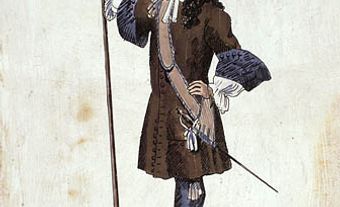
Colbert sent the Filles du Roi as an incentive for male workers who had finished their contract and soldiers of the Carignan-Salières regiment (which had just been demobilized) to settle in the colony.
The King took charge of recruiting, clothing and covering the cost of the royal wards’ travel within France and across the Atlantic. He gave each an allowance of 100 pounds: 10 pounds in recruitment fees, 30 pounds to gather a modest trousseau and 60 pounds for each woman’s passage fee.
The Filles du Roi were recruited from the regions of La Rochelle, Rouen and Paris. Often orphans with very little money, most of them were from urban areas. They were approximately 16 to 40 years old when they arrived, with an average age of 24. Between 1667 and 1672, many women (41 per cent) were given a royal dowry of 50 livres tournois (pounds) in addition to their trousseau. Some received even higher amounts (100 or 200 pounds). In years of financial hardship, the dowry of 50 pounds was replaced with provisions from the king’s storehouses in the colony.
As in France, these women were expected to be able to feed and clothe their families. It’s said that each received a hope chest containing personal accessories: a comb; two coiffes (a type of hood), one made of taffeta and the other of gauze; a belt; a pair of hose; a pair of shoes; a pair of gloves; a bonnet; shoelaces; and four sets of laces. These items would be difficult to find on the shores of the St. Lawrence. The chest also contained sewing supplies: about 100 needles, a case and thimble, white and grey thread, scissors, many pins, two knives, as well as cloth fine enough to make handkerchiefs, collars, wimples and pleated sleeves.
Settlement in New France
Upon their arrival in Canada, the Filles du Roi received room and board until they were married. Almost all of them quickly married. According to administrative reports, many were ill-prepared for an arduous life in rural Canada. However, they rose to the challenge: because of the sparse population and the wealth of food resources in their new home, they were able to have many children and to live longer than their peers who had stayed in France.
Legacy and Commemoration
The Filles du Roi, who had many offspring, are the maternal ancestors of thousands of North Americans. Because they came from the French-speaking regions and institutions of France, they contributed to Louis XIV’s longed-for standardization of the French language in 17th-century Canada.
Commemorative plaques in their honour can be found in the historic district of Old Quebec (Maison Barbel) and in Montreal (Maison Saint-Gabriel). In 2013, the 350th anniversary of the first voyage of the Filles du Roi was celebrated with various commemorative activities in both France and Quebec. Quebec’s Ministère de la Culture et des Communications designated the arrival of the Filles du Roi in New France a historic event on 11 July 2013. The role of the Filles du Roi in populating New France was also highlighted in a temporary exhibition for the 350th anniversary of the arrival of the Carignan-Salières regiment, presented at Château Ramezay in collaboration with the Commission franco-québécoise des lieux de mémoire communs.